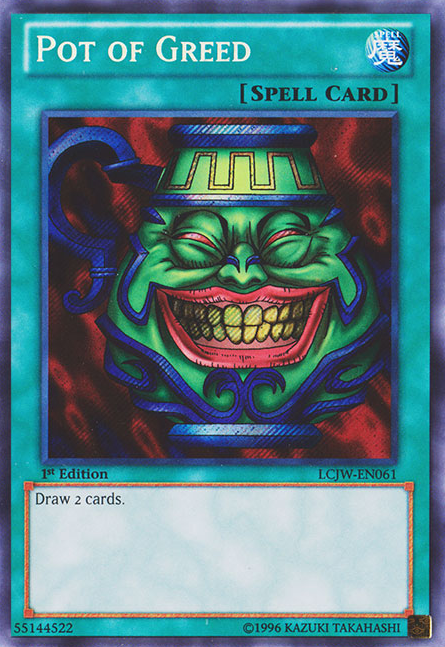
Pot of Greed has been a subject of fascination and controversy among Yu-Gi-Oh! enthusiasts for years. This card, with its deceptively simple effect, has left a lasting imprint on the game’s history and strategic landscape.
Table of Contents
- Why is Pot of Greed banned?
- What are the effects of Pot of Greed?
- What is the price of Pot of Greed?
- How has Pot of Greed influenced Yu-Gi-Oh! strategies?
- What are the most popular Pot of Greed memes?
- How is Pot of Greed referenced in other card games?
- Related questions about Pot of Greed and its role in Yu-Gi-Oh!
Why is Pot of Greed banned?
The ban of Pot of Greed from official Yu-Gi-Oh! play is rooted in the card’s potent ability to provide a player with an immediate and cost-free card advantage. Drawing two extra cards without any trade-off unbalances the game, reducing the challenge of strategic resource management. The decision to classify it as a forbidden card serves to maintain fair competition and diversified gameplay, which are core values of the Yu-Gi-Oh! gaming philosophy.
Understanding Pot of Greed and its ban is crucial for players who seek to grasp the complex dynamics that govern the rules and banned card lists. The card’s removal from tournament play echoes the ongoing efforts of game designers to keep the play environment challenging and engaging.

Within the Yu-Gi-Oh! community, the absence of Pot of Greed has sparked discussions on the delicate balance between powerful card effects and the overall health of the game’s ecosystem. It serves as a case study in the importance of restrictions for sustaining the strategic depth that players cherish.
What are the effects of Pot of Greed?
The primary effect of Pot of Greed is straightforward: it allows the player to draw two cards from their deck. However, the implications of this are far-reaching. By thinning the deck and increasing hand size, players quickly access key components of their strategy, thus accelerating their game plan with little to no cost. This card draw mechanism significantly enhances the likelihood of drawing into solutions or combo pieces, sometimes leading to swift, unanticipated victories.

From a game mechanics perspective, Pot of Greed embodies the essence of card advantage—a foundational concept in trading card games. This advantage, while seeming minimal, can shift the tide of a match, making the card a powerhouse in any deck it’s included in.
Card effects like those of Pot of Greed are essential to consider in effective deck building, as they can substantially impact a player’s ability to execute their strategy in a match. Proper understanding of such effects is what distinguishes seasoned players from novices in the competitive sphere of Yu-Gi-Oh!.

What is the price of Pot of Greed?
As a card with a significant historical legacy, Pot of Greed’s price can vary widely depending on the edition and condition. Collectors and players alike may seek out original prints or rare editions, which command higher prices in the market. A first edition Pot of Greed, for instance, might hold considerable value to collectors due to its status as a collectible from the early days of Yu-Gi-Oh!.
The price also reflects the card’s impact on the game and its iconic status within the community. Although it is banned from tournament play, its notoriety and the nostalgia it evokes contribute to its desirability and, by extension, its market value.

When inquiring about a card’s market value, resources like the Yu-Gi-Oh! Neuron app or online trading platforms can provide current pricing information, which is particularly useful for collectors and players interested in acquiring or selling a piece of Yu-Gi-Oh! history.

How has Pot of Greed influenced Yu-Gi-Oh! strategies?
The influence of Pot of Greed on Yu-Gi-Oh! strategies cannot be overstated. Its ability to provide an instant boost in card resources reshaped the way players constructed their decks and planned their moves. The card’s simplicity encouraged players to incorporate it into nearly any strategy, as it effortlessly meshed with diverse archetypes and playstyles.
Despite its ban, the legacy of Pot of Greed persists in the strategic approach players take towards deck construction. It serves as a benchmark for evaluating the efficiency of other card draw mechanics and influences the design of new cards that aim to offer strategic depth without disrupting the balance of the game.

Strategies in Yu-Gi-Oh! often revolve around maximizing card advantage while minimizing costs, a concept that Pot of Greed epitomized. Its impact is a testament to the ongoing evolution of deck construction methodologies and the tactical intricacies that define the Yu-Gi-Oh! experience.
What are the most popular Pot of Greed memes?
Pot of Greed’s reputation extends beyond the confines of gameplay into the realm of internet culture, where it has inspired a myriad of memes. The card’s straightforward yet impactful effect has been the subject of humorous exaggeration, with memes often poking fun at its banned status or the repetitive explanation of its effect in the Yu-Gi-Oh! anime series.

Memes serve as a form of social commentary within the community, reflecting players’ sentiments and shared experiences. The popularity of Pot of Greed memes highlights the card’s cultural significance and the sense of camaraderie among fans of the game.
Platforms like Reddit, Twitter, and other social media sites are hotspots for these memes, where the legacy of Pot of Greed continues to thrive in digital form, earning it a place in the annals of Yu-Gi-Oh! folklore.

How is Pot of Greed referenced in other card games?
The concept of Pot of Greed has influenced card design in other trading card games, where the idea of risk-free card draw has been explored with various twists and balances. Game designers often reference the card as an example of the potent effects that need careful moderation to prevent overpowering combos or strategies.
In some cases, similar cards are introduced with additional costs or conditions to mitigate the impact on gameplay, illustrating the lasting influence of Pot of Greed’s design on the broader genre of trading card games.

By studying its application in Yu-Gi-Oh! and other games, designers and players alike can gain insights into the delicate art of card balance and the intricacies of strategic game design.
Related questions about Pot of Greed and its role in Yu-Gi-Oh!
Why was Pot of Greed banned?
The ban of Pot of Greed was implemented to preserve the competitive integrity of Yu-Gi-Oh! matches. Its uncostly effect led to less variance and more predictable outcomes, compelling the game’s authorities to remove it from tournament-legal play to maintain a diverse and strategically complex environment.

By prohibiting cards like Pot of Greed, the game’s regulators ensure that players must carefully consider each card’s inclusion in their decks, fostering a more skillful and less luck-dependent game.
What is the Pot of Greed?
Pot of Greed is an iconic spell card in the Yu-Gi-Oh! trading card game known for its simple yet powerful effect of allowing the player to draw two additional cards from their deck. It has been the subject of much discussion due to its power level and subsequent ban.
The card represents a classic example of a game element that, while seeming innocuous, can have profound implications for competitive play and game balance.

Was Pot of Greed ever draw 3?
No, Pot of Greed has always had the effect of allowing the player to draw two cards and not three. Any confusion likely stems from jokes or misunderstandings within the community, as the card’s effect has remained consistent since its introduction.
The notion of drawing three cards would only further amplify the issues that led to its ban and would make it even more unbalanced in the context of gameplay.

How much is a first edition Pot of Greed?
The value of a first edition Pot of Greed largely depends on its condition and the specific print run. Prices can range significantly, with mint condition or graded copies fetching a premium in the collector’s market.
Prospective buyers or sellers are advised to consult up-to-date pricing guides or to engage with the trading community to determine the current value of their card.